Tony Kavanagh

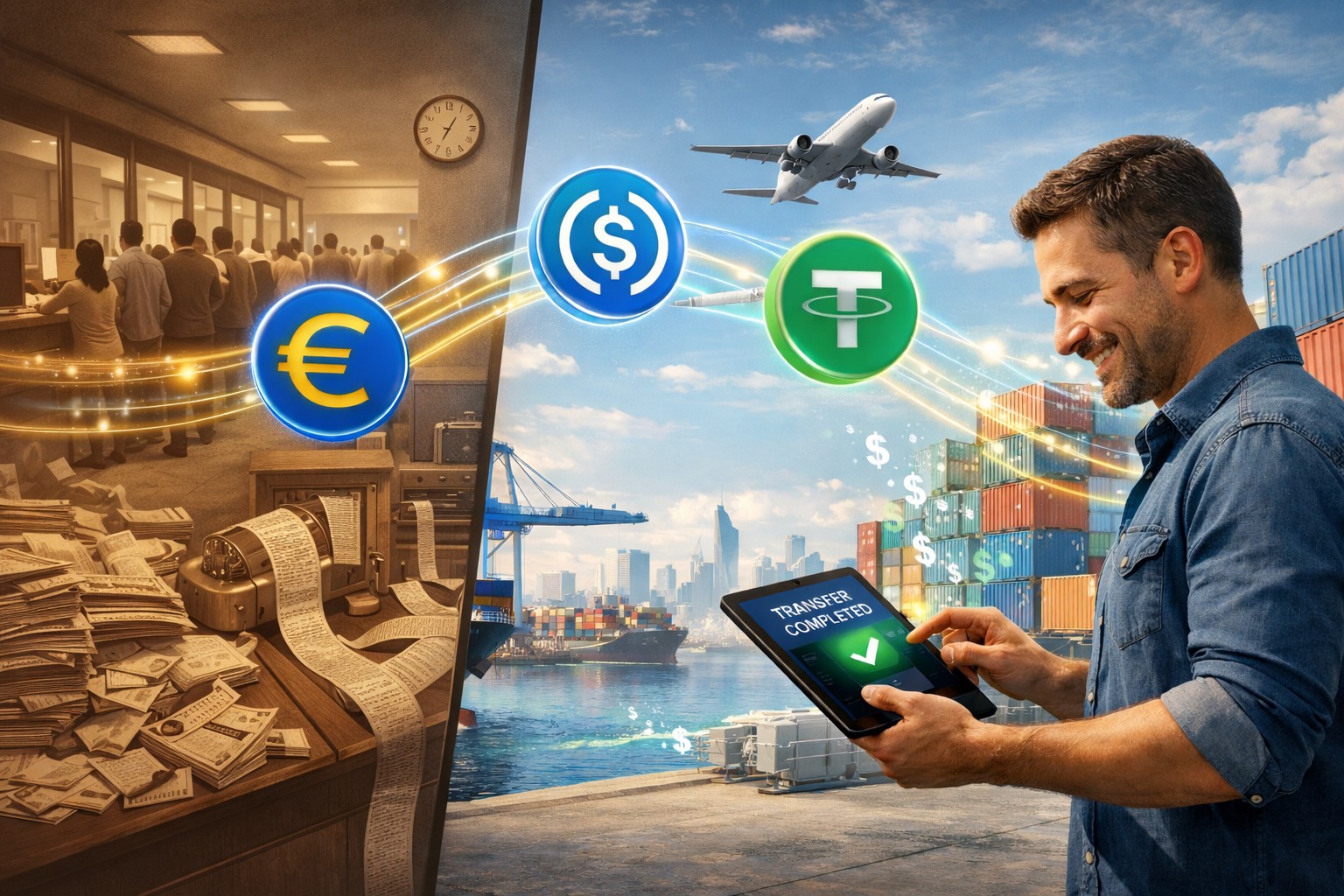
International trade still runs on an odd contradiction: containers move at near real-time speed, while the information that proves ownership, triggers release, and unlocks finance still crawls along in envelopes and email attachments. The result is friction that everyone recognizes—and yet the industry tolerates because the “paper way” is deeply embedded in law, custom, and operational muscle memory.
That inertia is measurable:
- A typical trade transaction can involve ~27 documents and a long chain of stakeholders and agencies. ICC United Kingdom
- The ecosystem still circulates billions of paper documents, with widely cited estimates pointing to around four billion in the system at scale. Bloomberg
- Less than ~1% of bills of lading are handled digitally in many mainstream estimates—despite the bill of lading’s central role in controlling and financing goods in transit. ICC United Kingdom
Yet the direction of travel is unmistakable: trade is moving from “paper as proof” to data as protocol—where the rules, the legal enforceability, and the technical standards are designed for digital-first execution.
Three building blocks are making that shift practical and scalable today:
- ICC’s URDTT (Uniform Rules for Digital Trade Transactions)
- UNCITRAL’s MLETR (Model Law on Electronic Transferable Records)
- ICC’s Digital Standards Initiative (DSI) and the broader push for interoperability
1. The breakthrough: trade stops “presenting paper” and starts “submitting data”
The ICC Uniform Rules for Digital Trade Transactions (URDTT) are written for digital-native trade. They are explicitly technology-neutral and messaging-standard neutral, meaning they don’t force the market onto one platform or one proprietary rail. Instead, they define how parties agree, exchange, authenticate, and rely on electronic records so that a digital transaction carries the certainty historically associated with paper. McKinsey & Company
URDTT also matters because it is built for real-world trade, not just bank-to-bank messaging:
- It supports digital trade transactions across multiple parties and roles
- It provides a consistent “rulebook layer” for digital documents and data exchange
- It is designed to align with model laws such as MLETR to reduce legal ambiguity McKinsey & Company
What changes in practice? Trade stops treating documentation as static artifacts and starts treating documentation as structured, verifiable information moving through an agreed workflow.
2. The legal engine: MLETR makes electronic originals possible
Going paperless is not just about scanning documents. The hard part is replacing the legal function of paper originals—especially for documents that are transferable (like a bill of lading, bill of exchange, or promissory note).
That’s exactly what UNCITRAL’s MLETR (2017) enables. It provides a framework so an electronic transferable record can be legally equivalent to a paper transferable document, as long as a “reliable method” establishes:
- Identification of the electronic record
- Integrity (it hasn’t been tampered with)
- Control (a digital equivalent of possession, so it can’t be “held” by two parties at once)
This is the moment trade moves beyond “PDF attachments” into digitally native instruments—records that can be transferred, pledged, or financed with confidence.
3. The reality check: why inertia persists (and why it’s finally breaking)
Paper persists because it works—even when it’s slow and expensive. It’s familiar, widely accepted, and embedded in legacy processes.
Common sources of inertia include:
- Legal fragmentation: many jurisdictions historically require paper for key trade documents, or lack clarity on electronic originals. ICC United Kingdom
- Network effects: digitisation only pays off fully when shipping lines, freight forwarders, banks, insurers, and authorities adopt interoperable methods together.
- Operational risk: businesses worry about disputes, enforceability, and whether counterparties will accept digital documents consistently.
But the break is now visible in adoption signals and policy change:
- In the UK, the Electronic Trade Documents Act is positioned as removing barriers tied to paper-based laws, with the government estimating a net benefit of £1.14 billion over the next decade for the British economy. GOV.UK
- Globally, the push to digitise trade processes is increasingly benchmarked and compared; UNCTAD highlights countries showing very high trade digitalisation rates (e.g., Netherlands and New Zealand at 96% in its referenced comparisons). UNCTAD
The direction is not “maybe.” It’s active policy, active standards work, and active commercial commitment.
4. The adoption curve: eBL is the canary in the coal mine
If you want to see where paperless trade is headed, watch the electronic Bill of Lading (eBL)—because it is one of the most paper-entrenched and economically important documents in shipping.
Here’s what the adoption picture looks like:
- In 2021, only ~1.2% of an estimated 45 million bills of lading issued were electronic (a commonly cited benchmark in industry reporting). Seatrade Maritime News
- In 2023, DCSA member carriers publicly commit to 50% eBL within five years and 100% by 2030—a concrete, time-bound target from the core of container shipping. DCSA
- Some industry bodies and programs report tangible usage numbers and pledges (e.g., case-study calls and tracking of issued eBL volumes). ESCAP
This matters because eBL adoption is a forcing function:
- It drives interoperability requirements
- It accelerates legal alignment efforts
- It proves that “digital originals” can work across borders, not just within one company
When eBL scales, the rest of the documentation stack tends to follow.
5. The execution layer: standards turn good intentions into working systems
Rules and laws are necessary—but adoption happens when implementation is straightforward across a fragmented supply chain.
That’s why the ICC Digital Standards Initiative (DSI) exists: it pushes a globally harmonised digital trade environment and promotes alignment across public and private stakeholders. ICC-DSI
Put simply:
- URDTT provides the digital trade rulebook layer. McKinsey & Company
- MLETR provides the legal framework for electronic originals and transferable records. OECD
- DSI and industry standards bodies push interoperability so systems can “talk” and records can be relied upon end-to-end. ICC-DSI
This is how trade moves from “digital islands” to a digital network.
6. From paper to protocol: what the future-state looks like (and why it feels different)
When URDTT-aligned workflows meet MLETR-enabled electronic originals, trade starts behaving like modern software:
- A shared workflow replaces scattered email threads and courier packages.
- Transferable records become controllable digital assets, not stamped folders.
- Events become trackable states (issued → accepted → transferred → financed → released).
- Disputes become rarer and faster to resolve because integrity and auditability are built into the process. McKinsey & Company
This is not a “sci-fi trade future.” It is the natural outcome of rules, law, and standards converging.
7. Where iTradeDigital fits: making paperless trade operational
This is the lane iTradeDigital is building for.
iTradeDigital uniquely offers the only URDTT-compliant online platform that digitises and automates the documentation and workflow required for cross-border trade—aiming to make trade simpler, faster, and more accessible. Corporates.db.com
In practical terms, iTradeDigital helps move the market from “paper as process” to “protocol as process” by:
- Capturing transaction data once and reusing it across required documents
- Creating an auditable, collaborative workflow between buyer, seller, and supporting parties
- Aligning with modern rule frameworks (URDTT) that support digital-native execution Corporates.db.com
The endgame is clear: a paper-less trade future where electronic transferable records become normal, enforceable, and interoperable—enabled by frameworks like MLETR, guided by the ICC’s rulebooks, and accelerated by industry-wide commitments like 100% eBL by 2030. DCSA.
Paper doesn’t disappear overnight. But the market is already moving from paper to protocol—and iTradeDigital is helping turn that shift into a working reality, not a concept slide.